
MASK ALIGNERS
Over the past two decades, NxQ evolved from a supplier of traditional contact/proximity aligners into a developer of modular, scalable lithography platforms supporting applications such as MEMS, wafer-level packaging, compound semiconductors, microfluidics, optoelectronics, biotechnology, and advanced packaging.
The evolution of the product line included several important technology advances:
- The introduction of the NxQ 4000 Series created an affordable platform for universities, pilot lines, and R&D facilities.
- The NxQ 8000 Series became the company’s flagship scalable production platform, designed to bridge R&D and high-volume manufacturing with robotic automation and advanced backside alignment capability.
- In 2015, NxQ introduced the NxQ 8012 platform supporting substrates up to 300mm (12-inch), expanding into larger wafer and advanced packaging markets.
- More recently, the company introduced the NxQ 8000 CT Cluster Tool and the NxQ 9000 Series large-area and roll-to-roll lithography systems, targeting next-generation packaging, energy storage, and flexible electronics applications.
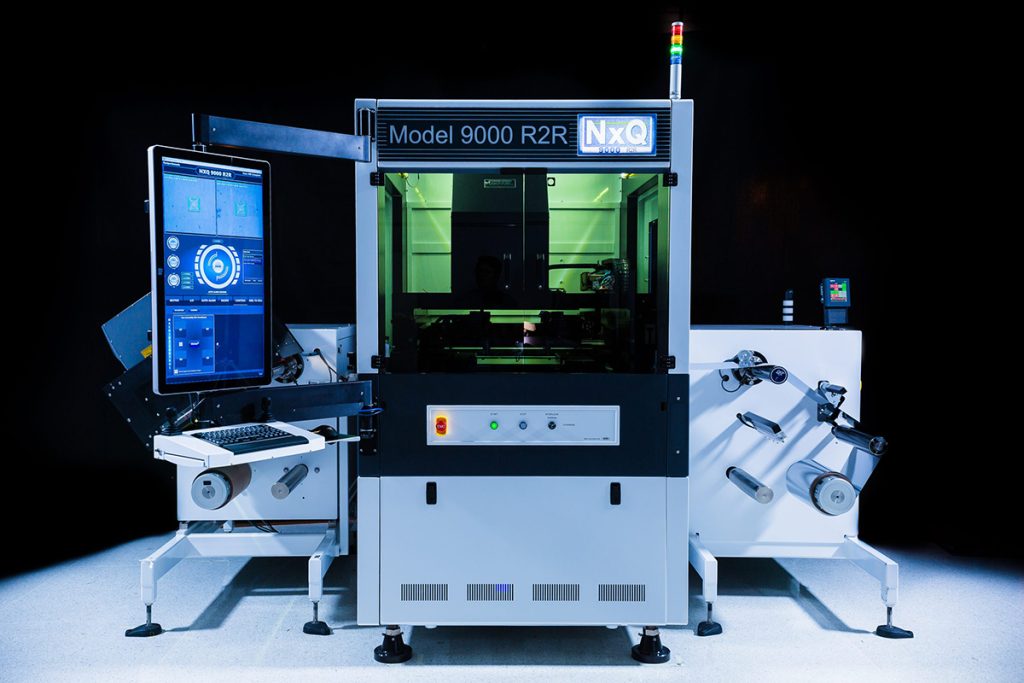
NxQ 9000 SERIES—first-of-its-kind 1x proximity stepper in the marketplace for full field or step and repeat exposures. Available in Roll to Roll or large area substrate formats.
NxQ 9000 SERIES— Open architecture modular design The NxQ 8300 300mm Bridge Tool is now available for purchase.
NxQ 8012 ML SERIES—NxQ 8012 Manual Load Mask Aligner is now
NxQ 8008 CT SERIES—Cluster Tool series offers a scalable, high volume production platform.
NxQ 8000 AL SERIES—Auto Load series offers a scalable, high volume production platform
NxQ 8000 ML SERIES—Manual Load Series Mask Aligner Precision Alignment for Demanding
NxQ 4000 SERIES—is a cost-effective product designed for R&D, universities and pilot line
NxQ LumeX FES—Flood Exposure System
The Neutronix NxQ mask aligner and lithography platforms support a broad range of photolithography applications across semiconductor, advanced packaging, MEMS, optoelectronics, biomedical, and research markets, including:
These applications benefit from the NxQ platform’s precision alignment, contact and proximity exposure modes, scalable automation, and support for substrates ranging from small wafers to large-area and roll-to-roll formats.
NxQ also became an early advocate of UV-LED exposure technology as an alternative to traditional mercury lamp exposure systems. Their latest LumeX Flood Exposure System reflects the company’s focus on reducing operating costs, improving sustainability, and modernizing lithography workflows.
Today, Neutronix Quintel is recognized as one of the long-standing independent mask aligner manufacturers in the semiconductor industry, with more than 35 years of experience delivering photolithography solutions for both research and production environments worldwide.
- Advanced Packaging and Fan-Out Wafer Level Packaging (FOWLP)
- Redistribution Layer (RDL) patterning
- Thick photoresist processing for high aspect ratio structures
- MEMS fabrication and sensor manufacturing
- Compound semiconductor device fabrication
- Power semiconductor processing
- Microfluidic device fabrication
- Wafer bumping and under bump metallization (UBM)
- Through-silicon via (TSV) processing
- Glass wafer and panel processing
- LED and optoelectronic device manufacturing
- Flexible hybrid electronics and roll-to-roll lithography
- PCB and substrate lithography
- Nanoimprint lithography (NIL)
- BioMEMS and lab-on-chip device fabrication
- Front-to-back alignment applications
- Wafer-level optics and photonics manufacturing
- University and research laboratory prototyping
- Pilot line and process development
- High-volume semiconductor manufacturing (HVM)
- Large-area substrate lithography
- Ceramic and specialty substrate processing
- Thick copper plating resist patterning
- Micro-battery and energy device fabrication
- Photonic integrated circuit (PIC) manufacturing
- Sensor and RF device fabrication
- Quantum device and advanced materials research
The primary advantage of the Neutronix NxQ mask aligner platform over competing systems such as Suss, EV Group, and Heidelberg, is its combination of modular scalability, process flexibility, and cost-effective high-precision performance across both R&D and high-volume manufacturing environments.
Key differentiators in Mask Aligners include:
Open Architecture Design
NxQ systems are built with a modular, open-platform architecture that allows customers to configure, upgrade, and adapt tools as process requirements evolve — from manual R&D setups to fully automated production environments.
Scalable from R&D to HVM
Unlike many systems that require replacing equipment as production scales, NxQ platforms can grow from university research and pilot lines into high-volume manufacturing through automation and robotic upgrades.
Broad Process Flexibility
The systems support contact, vacuum contact, and proximity lithography modes, enabling a wide range of applications including advanced packaging, MEMS, compound semiconductors, thick resist processing, and large-area substrates.
Large Area and Roll-to-Roll Capability
The NxQ 9000 Series uniquely supports large-format substrates and roll-to-roll processing with 1x proximity stepper functionality — a capability not commonly available in traditional mask aligners.
Precision Alignment
Perfect for Advanced Applications Sub-micron alignment capability, front-to-back overlay inspection, and AI-enhanced alignment technologies help support demanding next-generation semiconductor and packaging processes.
Lower Cost of Ownership
NxQ systems are designed to provide advanced lithography capabilities without the cost and complexity of stepper systems, while modular upgrades reduce the need for complete tool replacement.
Compact
Production-Friendly Footprint with Efficient layouts, minimized particle generation, and automation-ready platforms make NxQ tools attractive for cleanroom integration and throughput optimization.
UV-LED Exposure Innovation
The NxQ LumeX Flood Exposure System replaces traditional mercury lamps with UV-LED technology, reducing maintenance, lowering operating costs, improving energy efficiency, and enabling instant-on exposure control.
Whether customers require manual load flexibility, automated high-throughput production, large-format exposure, or next-generation UV-LED flood exposure technology, the NxQ platform provides a cost-effective and future-ready path for evolving process demands while maintaining exceptional alignment accuracy, operational efficiency, and manufacturing scalability.
Overall, NxQ’s competitive strength comes from delivering high-performance lithography with exceptional flexibility and upgradeability, allowing customers to future-proof their manufacturing investment while supporting both current and emerging photolithography applications.
The company was established to provide cost-effective, production-ready photolithography and mask alignment systems for semiconductor manufacturers, research institutions, and emerging technology companies. From advanced R&D environments to high-volume semiconductor manufacturing, the Neutronix NxQ portfolio of mask aligners and lithography systems delivers scalable, precision-driven solutions for a wide range of photolithography applications. Engineered with open-architecture modularity, precision alignment technology, and flexible exposure capabilities, the NxQ series supports everything from university research and pilot production to advanced packaging, MEMS, compound semiconductors, and large-area substrate processing.
After Neutronix acquired Quintel Corporation, forming NxQ it combined decades of lithography expertise and expanded the company’s capabilities in mask aligner engineering, metrology, backside alignment, and advanced packaging applications.
Over the past two decades, NxQ evolved from a supplier of traditional contact/proximity aligners into a developer of modular, scalable lithography platforms supporting applications such as MEMS, wafer-level packaging, compound semiconductors, microfluidics, optoelectronics, biotechnology, and advanced packaging.
